
Spiritual Journey
An Open Itinerary for a Spiritual Pilgrimage
Overview
“Where the air is pure, the mountains hold their breath, and the mind finally comes home.”
Your journey begins the moment you step off the plane at Paro International Airport —one of the most breathtaking airport approaches on earth, tucked between pine-covered ridges in the Paro Valley. You will be greeted with a traditional white khata (ceremonial scarf) as a symbol of purity and goodwill. From here, you are no longer a visitor. In Bhutan, a guest is treated as family — you will find yourself more at home here than you expected to be anywhere.
Duration
06 Days 05 Nights
Season
Spring & Autumn
Altitude
3800m
Day1: Paro: Tara Temple, Gorina
Your first full day begins with Tara Temple in Gorina, set high above the Paro Valley. The trail rises through pine forest strung with fluttering prayer flags, the air growing thinner and clearer with every step, until the temple appears at the top — offering a heaven-wide view over the entire valley below, mountains folding into mountains in every direction.
At the temple, you will be welcomed to take part in a traditional smoke offering (Sangchö/Lhasang) puja, guided by a local practitioner. You will learn to prepare and burn juniper branches, incense, and roasted grains — an offering of pure scent believed to please the awakened deities, settle karmic debts to unseen beings, and bring relief to all sentient beings. It is a quiet, elemental ritual: fire, fragrant smoke, and intention rising together into open sky.
Afterward, settle in for an outdoor picnic lunch just in front of the temple, featuring local organic Bhutanese fare — red rice, ema datshi (chili and cheese), seasonal vegetables, and butter tea — with the valley spread out below you. It is a taste, and a view, meant to stay with you long after you’ve left.
Day 2: Paro: Life at a Nunnery, and a Puja for Your Path
Today you visit a Buddhist nunnery in Paro, home to anim (Bhutanese nuns) who have chosen a life of renunciation and disciplined practice. You’ll spend time in quiet conversation with the nuns, learning about their daily rhythm of prayer, study, and community life — a path pursued with the same devotion and rigor as their monk counterparts, often with far less recognition.As a guest, you will be offered the rare opportunity to witness — and have performed on your behalf — an obstacle-removing puja (a Barched Lamsel or similar ritual), intended to clear hindrances from your path and set positive intention for the remainder of your journey. Sitting in the temple as chanting and ritual instruments fill the room is, for many travelers, one of the most moving parts of the entire trip.
Day 3: Thimphu: The Great Buddha and the Wind Horse
Travel today to Thimphu, Bhutan’s capital, nestled in a wide valley along the Wang Chhu river. Your destination is the Buddha Dordenma — one of the largest seated Buddha statues in the world, gazing serenely over the entire Thimphu valley from its hillside perch. Take time here for quiet prayer and personal reflection, surrounded by hundreds of smaller Buddha statues housed within.
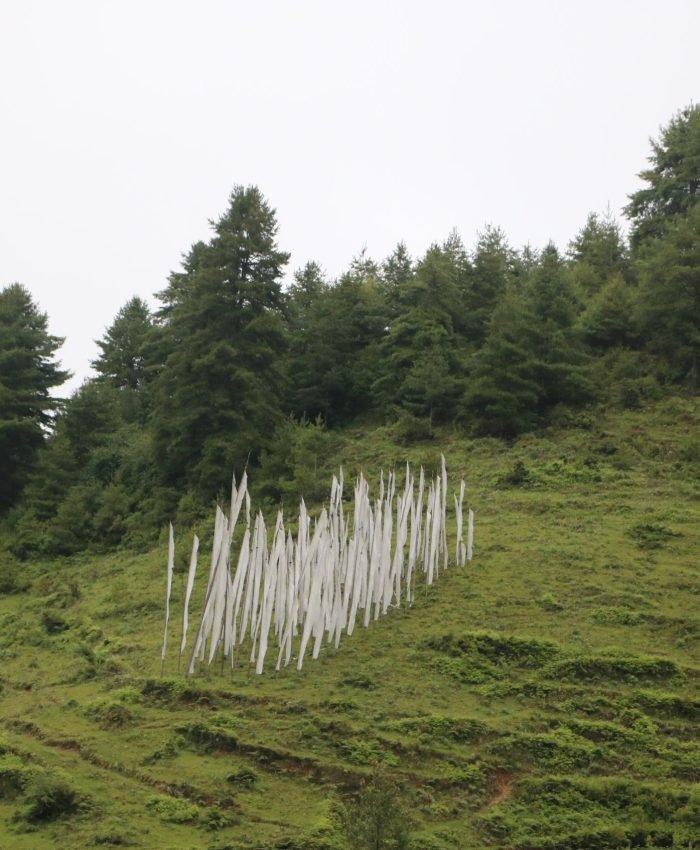
In the afternoon, you’ll take part in a prayer flag hanging ceremony. Lungta, meaning “Wind Horse” in Tibetan, are the horizontal strings of colored flags you’ll see everywhere in Bhutan — strung across mountain passes, rooftops, and riverbanks. Each flag is printed with mantras and prayers that are believed to be carried outward on the wind, spreading blessings, compassion, and good fortune to all beings they touch. Hanging your own string of Lungta is a small, personal act of generosity cast out into the world.
Day 4: Thimphu: Kora at the Chorten, and a Gesture of Karmic Merit
This morning, join local devotees in circumambulating the Thimphu Memorial Chorten — walking clockwise around the stupa. Completing 108 rounds (a number sacred across Buddhist tradition) is believed to purify the mind, fulfill sincere wishes, and strengthen one’s spiritual presence. Take it at your own pace; many pilgrims spread the rounds across the morning, pausing to rest, reflect, or simply watch the steady rhythm of elderly devotees who circle the chorten daily as part of their life’s practice.
Afterward, you’ll have the chance to offer water, tea, or light refreshments to the elderly pilgrims doing their own kora. In Bhutanese Buddhist practice, this small act of generosity — sharing what you have with those still walking their path — is considered a genuine karmic merit, as meaningful as any grand offering.
Day 5: Thimphu: A Day in the Life of a Monk at Pangrizampa
Your 5th day takes you to Pangrizampa, Thimphu’s centuries-old astrology college, where monks train in traditional Bhutanese astrology, ritual, and Buddhist philosophy beneath old cypress trees said to have been planted by Bhutan’s great saints. Here, you won’t just observe — you’ll sit down with the monks and experience an ordinary day of monastic life: shared meals, quiet study, ritual prayer, and unhurried conversation.
It is a gentle, grounding way to spend a day — a glimpse into a rhythm of life built entirely around presence and devotion, existing quietly in the same world you came from, yet utterly its own.
Day 6: Paro: Ascending to Taktsang, the Tiger's Nest
Your journey closes the way every pilgrim to Bhutan dreams of ending it: with the climb to Taktsang Palphug Monastery, the “Tiger’s Nest,” perched dramatically on a cliffside above the Paro Valley. The trail winds upward through blue pine forest strung with fluttering prayer flags, the air growing thinner and clearer with every step, until the monastery itself appear — seemingly suspended in space against the mountain face.
Take your time inside its clustered chapels, each one steeped in the legend of Guru Rinpoche, who is said to have flown to this very cliff on the back of a tigress to subdue a local demon and bring Buddhism to the Paro Valley. Sit for a while in quiet reflection before beginning the descent — a fitting final ascent for a journey that began at the top of another mountain,and ends here, having come full circle.
Many travelers say this final climb is the moment the trip stops feeling like sightseeing and starts feeling like something they’ll carry home with them for good.
Quick Info
Fitness: The Taktsang hike on Day 5 is the most physically demanding part of the trip— roughly 4–5 hours round trip with a steady uphill climb. Ponies are available partway for those who prefer.
Privacy: Your Pranic Healing session is conducted one-on-one and held in confidence.
Dress: Modest, comfortable clothing is recommended throughout, with shoulders and knees covered at temples and monasteries.
Guide & permits: All travel in Bhutan requires a licensed local guide and a Sustainable Development Fee, typically arranged through a registered Bhutanese tour operator before arrival
Includes & Excludes
Includes
- Luxury or boutique accommodation throughout your stay
- Daily breakfast, lunch, and dinner as outlined in the itinerary
- Airport pick-up and drop-off within Bhutan
- Private transportation for all scheduled activities
- Professional English-speaking guide
- Experienced wellness facilitator throughout the journey
- Daily meditation and mindfulness sessions
- Pranic Healing and wellness activities (where included)
- Guided hiking and nature walks (as per itinerary)
- Visits to monasteries, temples, and cultural sites
- Entrance fees to all listed attractions
- Bottled drinking water during excursions
- Bhutan Sustainable Development Fee (SDF) (if included in your package)
- Government visa processing assistance
- All applicable government taxes and service charges
Excludes
- International airfare
- Travel insurance (strongly recommended)
- Personal expenses and shopping
- Alcoholic beverages and premium drinks
- Laundry services
- Spa treatments not included in the itinerary
- Optional activities and excursions
- Personal healing or private consultation sessions unless specified
- Tips and gratuities for guides and drivers
- Meals not mentioned in the itinerary
- Visa fees (if not included in your package)
- Expenses arising from flight delays, weather conditions, natural disasters, or unforeseen circumstances
